The Dual-Role Dilemma: Strategic Time Management for Working Professionals in UK Higher Education

The landscape of higher education across the United Kingdom is experiencing a major structural shift. No longer defined solely by the traditional school-leaver demographic, modern university cohorts are increasingly comprised of mature students, full-time professionals upskilling for a changing corporate market, and vocational trainees navigating demanding clinical or technical placements. According to contemporary demographic reviews within British higher education, a significant percentage of undergraduate and postgraduate scholars are classified as “student-workers”. These individuals must balance the rigorous demands of professional employment with the uncompromising standards of the UK credit framework.
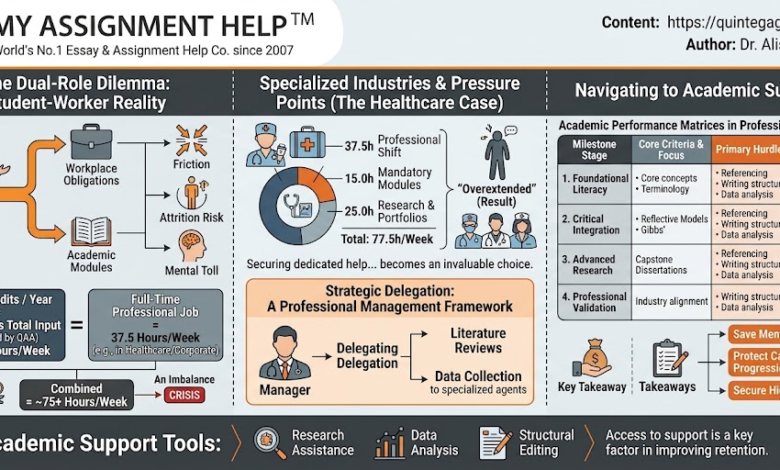
This dual-role reality introduces severe operational friction. When an individual is forced to split their finite weekly hours between professional workplace obligations, family responsibilities, and intensive modular research, something inevitably suffers. The mental and physical toll of maintaining this balance often leads to high attrition rates or forced academic intermission. To mitigate these systemic pressures, forward-thinking professionals utilize advanced project-management strategies to protect both their career progression and their academic standing. Within this framework, specialized external academic consulting frameworks play a vital role in providing essential structural support.
Dedicated educational agencies offer tailored academic guidance specifically designed to help overextended individuals manage complex modular requirements safely. When professional deadlines collide with rigid university submission windows, learning how to delegate foundational research tasks is a critical skill; using reliable services that help students do my coursework efficiently acts as a vital resource for maintaining consistent marks across all modules.
Key Takeaways
- The Credit Hour Reality: Every 10 university credits in the UK represent roughly 100 hours of total learning input, creating a severe time deficit for individuals working full-time.
- Strategic Outsourcing: Viewing academic support as a form of professional delegation allows student-workers to focus on practical, high-value career competencies.
- Preserving Mental Bandwidth: Managing modular stress through structured external consulting directly reduces academic burnout and improves workplace performance.
- Contextual Writing Metrics: Success in modern professional programs requires combining real-world industry insights with rigorous, evidence-based academic prose.
The Mathematics of the UK Credit Framework
To understand why the student-worker dilemma is so pronounced, one must analyze the formal workload metrics mandated by British higher education compliance standards. The standard academic year for a full-time undergraduate or postgraduate program in the UK translates to 120 credits. Under the standard Higher Education Credit Framework for England, Wales, and Northern Ireland, a single credit point represents a nominal 10 hours of dedicated student effort.
Consequently, a standard 120-credit academic year demands approximately 1,200 hours of total engagement. When broken down across standard teaching terms, this framework requires a commitment of 35 to 40 hours per week—the equivalent of a full-time job. For professionals who already work 37.5 hours a week in a corporate office or a shift-based healthcare setting, the math reveals an impossible reality: a 75-hour combined weekly workload before accounting for basic personal or family needs.
This extreme time deficit makes strategic time-management tools essential. Student-workers cannot rely on basic lifestyle changes like getting less sleep or using weekend study blocks; they must adopt formal project-management frameworks, clear operational boundaries, and reliable academic support structures to protect their career and educational investments.
Vocational Pressure Points: The Case of Specialized Industries
While general business or humanities modules introduce significant time-management hurdles, specialized occupational tracks present an even greater challenge. Programs in engineering, law, and corporate healthcare require students to balance heavy theoretical workloads with intense practical commitments.
In the medical and nursing sectors, for instance, trainees must complete thousands of hours of mandatory clinical placements alongside their standard university modules. These placements regularly feature grueling 12.5-hour day or night shifts on active hospital wards, leaving students physically and emotionally exhausted.
[UK Student-Worker Weekly Time Allocation]
├── Professional Employment (Shift / Office Work) -> 37.5 Hours
├── Mandatory Academic Modules (Lectures & Seminars) -> 15.0 Hours
└── Independent Research, Portfolios & Case Studies -> 25.0 Hours
─────────────────────────────────────────────────────────────────
Total Required Input: 77.5 Hours / Week (Available Peak Bandwidth: ~60 Hours)
Upon finishing these challenging shifts, students cannot simply rest; they must immediately shift focus to drafting complex clinical case reviews, analyzing pharmacological data, and compiling reflective practice journals. These technical assignments demand an advanced understanding of evidence-based practice and precise referencing styles. When faced with this intense pressure, managing continuous professional shifts alongside complex research papers can quickly become overwhelming. Under these conditions, securing dedicated healthcare assignment help becomes an invaluable strategic choice, enabling student nurses to maintain high academic standards without compromising their practical clinical training.
Academic Performance Matrices in Professional Degrees
To achieve a first-class or upper second-class (2:1) degree in professional UK programs, student-workers must move beyond basic descriptive writing. Modern university modules place a heavy emphasis on critical analysis, synthesis, and an understanding of how research applies directly to practical industry challenges. The matrix below outlines the critical milestones, performance parameters, and primary academic hurdles that define the path through a modern professional degree program.
| Milestone Stage | Core Performance Criteria & Learning Focus | Primary Academic Hurdles |
| Stage 1: Foundational Literacy | Mastering core concepts, standard industry terminology, and basic academic writing protocols. | Transitioning to formal academic prose; understanding complex referencing systems. |
| Stage 2: Critical Integration | Applying theoretical frameworks to real-world case studies; conducting basic literature reviews. | Writing structured reflective accounts using models like Gibbs’ Reflective Cycle. |
| Stage 3: Advanced Research | Synthesizing comprehensive data sets; conducting independent research for capstone dissertations. | Managing large-scale data analysis within tight operational deadlines. |
| Stage 4: Professional Validation | Aligning academic outputs with industry standards and continuous professional development (CPD) metrics. | Preparing professional-grade case portfolios for regulatory review. |
Strategic Delegation: A Professional Management Framework
In the corporate world, effective managers do not try to execute every task themselves; they maximize efficiency by delegating foundational work to trusted specialists so they can focus on high-value strategy. This same professional management framework can be applied to higher education.
By viewing academic support as a legitimate form of professional delegation, student-workers can manage their workloads more effectively. Entrusting foundational literature reviews, data collection, and initial structural drafting to experienced academic consultants allows professionals to focus their limited time on mastering practical skills and preparing for core exams.
This approach does not compromise academic integrity; rather, it represents a practical response to an overextended lifestyle. It ensures that complex assignments are built on solid research foundations, helping busy professionals keep their academic goals on track while maintaining their performance in the workplace.
See also: Why Most Solar Panel Installation Cincinnati Projects Fail (And How to Avoid It)
Frequently Asked Questions (FAQs)
1. How does the UK university credit framework calculate student workload?
The UK credit framework calculates workload based on the principle that 1 credit point equals roughly 10 hours of total student effort. Therefore, a standard 20-credit module requires about 200 hours of work, including lectures, independent research, and assignment preparation.
2. Why do professional and vocational degrees require unique academic writing styles?
Professional and vocational degrees often require students to combine subjective, real-world workplace experiences with objective, evidence-based research. This approach is typically structured around formal frameworks like Gibbs’ Reflective Cycle to demonstrate strong clinical or operational reasoning.
3. How do external academic consulting services assist full-time workers?
External services help manage the time constraints of higher education by assisting with intensive research, data collection, and structural editing. This support allows full-time workers to balance their occupational duties without falling behind on key academic deadlines.
4. What is the impact of heavy assignment workloads on student retention?
Extensive research shows that unmanageable workloads are a primary cause of academic burnout and early withdrawal among mature and working students. Access to structured academic support systems is a key factor in improving retention rates across these demographics.
About the Author: Dr. Alistair Ross
Dr. Alistair Ross is a Senior Higher Education Curriculum Consultant and Academic Strategist. With over fifteen years of experience in British academia and professional development coaching, he specializes in designing comprehensive educational workflows that help non-traditional students and working professionals navigate the complexities of modern UK credit degrees.
References
- Quality Assurance Agency for Higher Education (QAA), 2024. The Higher Education Credit Framework for England: Advice and Guidance. Gloucester: QAA.
- Universities UK (UUK), 2023. Flexible Learning and the Modern Student-Worker Demographic. London: UUK Policy Press.
- National Institute for Health and Care Excellence (NICE), 2025. Professional Development Competency Frameworks in Vocational Education. London: NICE.